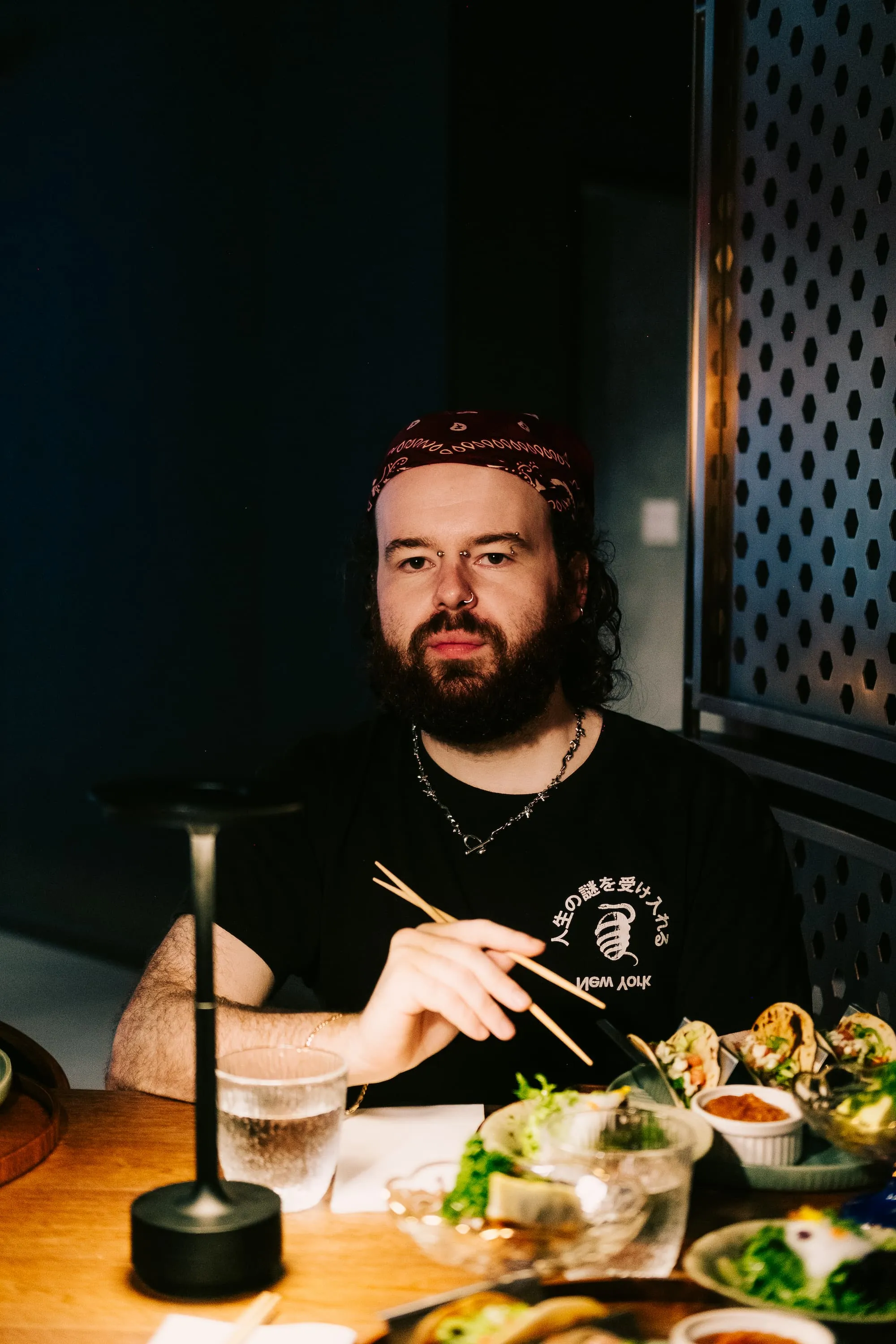








New Sardines stands as a playful, animated participant amongst the other works of art. From around the corner, Tristen Fabricant appears, smiling and holding sheets of an accompanying poem, a sidekick to the canvas, in his arms. Wearing translucent orange, bug-eye sunglasses and a matching bandana on his head, his warm persona and fashion style embody his chosen artist name, childsphlay. His demeanor reflects his art: excited and fantastical.
“You made it! Isn’t it great in here?”
Fabricant’s comment refers to this specific space on this Wednesday evening, but nods to his own journey as an artist. Both Good Work for Bad People and New Sardines marks a turning point in his creative endeavors. Together, they mark the debut of his relationship with experimentation and self-expression he has developed over the course of his life. Learning to sew, drawing inspiration from his love of old cartoon movies to hone his painting skills, and building a life for himself in New York City, he arrives at Studio 45 ready to welcome people into his artistic universe.
The Catskills native grew up with a love of the playful, animated life around him. His aunt Nancy, who accompanied the artist to celebrate New Sardines, used to bring home vintage, hand-drawn frames from Disney movies for her then-young nephew. Fabricant would spend hours flipping through the pages, drawn to the playful style and bold use of color. His grandmother further developed his appreciation for art through trips into the city. Visiting the Met, they’d marvel at Ancient Egypt artifacts and massive abstract paintings by some of history’s most renowned artists. In time, Fabricant grew to love experimenting with fantastical visual arts as a means of expression. He would pull from his childhood fascination with animated movie frames and groundbreaking artwork to inspire his own identity as an artist and person. No matter what medium he used to express himself, he remained close to his childlike spirit, seeing everything with fresh eyes and a beginner’s mind.
“I’d hope that everything I do, in some way, feels a little bit like a movie. Everything hopefully always feels somewhat playful.”
Visiting Brooklyn in high school, Fabricant spent the tips he’d made waiting tables at the Dancing Cat Saloon on bonsai trees. These jaunts represented not just a fun field trip but a return to the neighborhood where generations of his father’s family called home.
“My dad passed down all the love that he had for the city to me through genetics or something, because it just felt natural walking through New York City. It was just the one place that always felt natural.”
Alongside Fabricant’s early artistic influences, his practice is rooted in his heritage as a New Yorker and his connection to the Jewish community. The physical and religious lifestyles he’s come to call home are entwined with his self-expression.
“I grew up eating matzo ball soup and French fries with a seltzer and lemon. My father would always laugh at me. He’d tell me I sounded like an old man . . . I was 12. One big thing of Jewish culture is we complain about everything. If the sun touches it, we're going to complain about it. If the sun doesn't touch it, we'll complain about it. So, my art is just a long list of complaints. That’s what it boils down to, inspiration wise.”
Moving to New York after high school, Fabricant spent a few years experimenting with different apartments, neighborhoods, and jobs — corporate, hospitality, and restaurant. During COVID, when all three of his roommates left the city and he had a four-bedroom apartment in Chinatown all to himself, he began experimenting with embroidery and sewing, a passion dating back to his teenage love of fashion. Eventually combining painting with embroidery arts, he’s relished the journey of learning how to layer materials to fully personalize his craft. His playful experimentation created a form that he truly resonates with and now celebrates as he begins sharing his work with the community.
“It's a blessing to not be good at something in the beginning, right? It means that you're learning something new, and you can look back on it with such fond memories.”
As he deepened his connection to New York City, Fabricant evolved his relationship with various art mediums. His skills as a painter began to accelerate in 2023 when he learned which types of paint and fabric work best together, eventually landing on a combination of acrylic and muslin. Over the years, he’s learned to trust his process and celebrate the inevitable imperfections that come with challenging his comfort zone. Pulling from personal experiences of bad jobs, hard relationships, and frustrations with the world around him, Fabricant finds relief in turning towards his needles, paints, and fabrics. After a breakup, the artist dove into large-scale pieces with heightened animated elements, trusting his negative emotions to create something beautiful. The pieces that now hang in his apartment are a physical testament to moving through hard times.
“I would not have painted this painting, this painting, and this one. Things happen for a reason.”
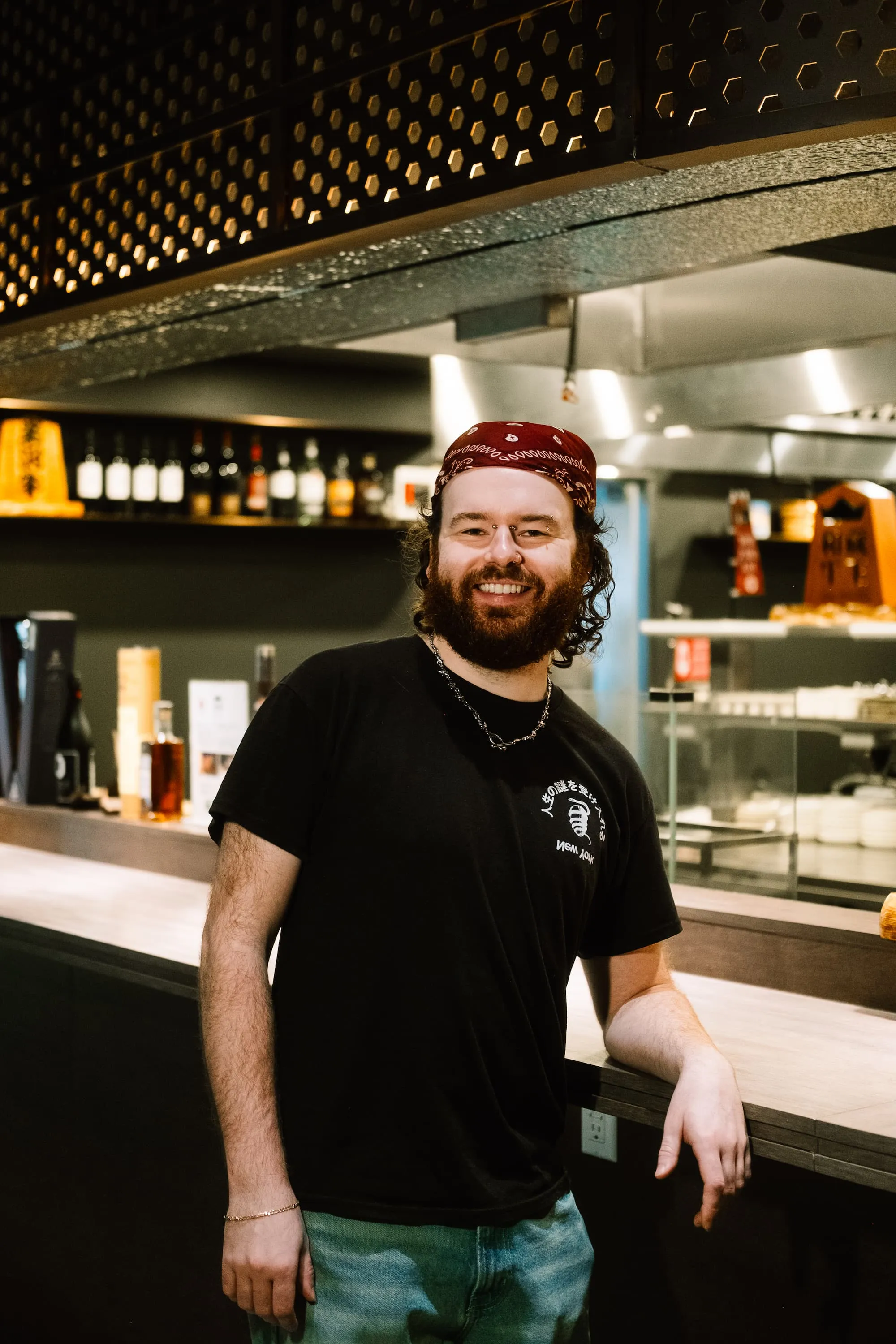
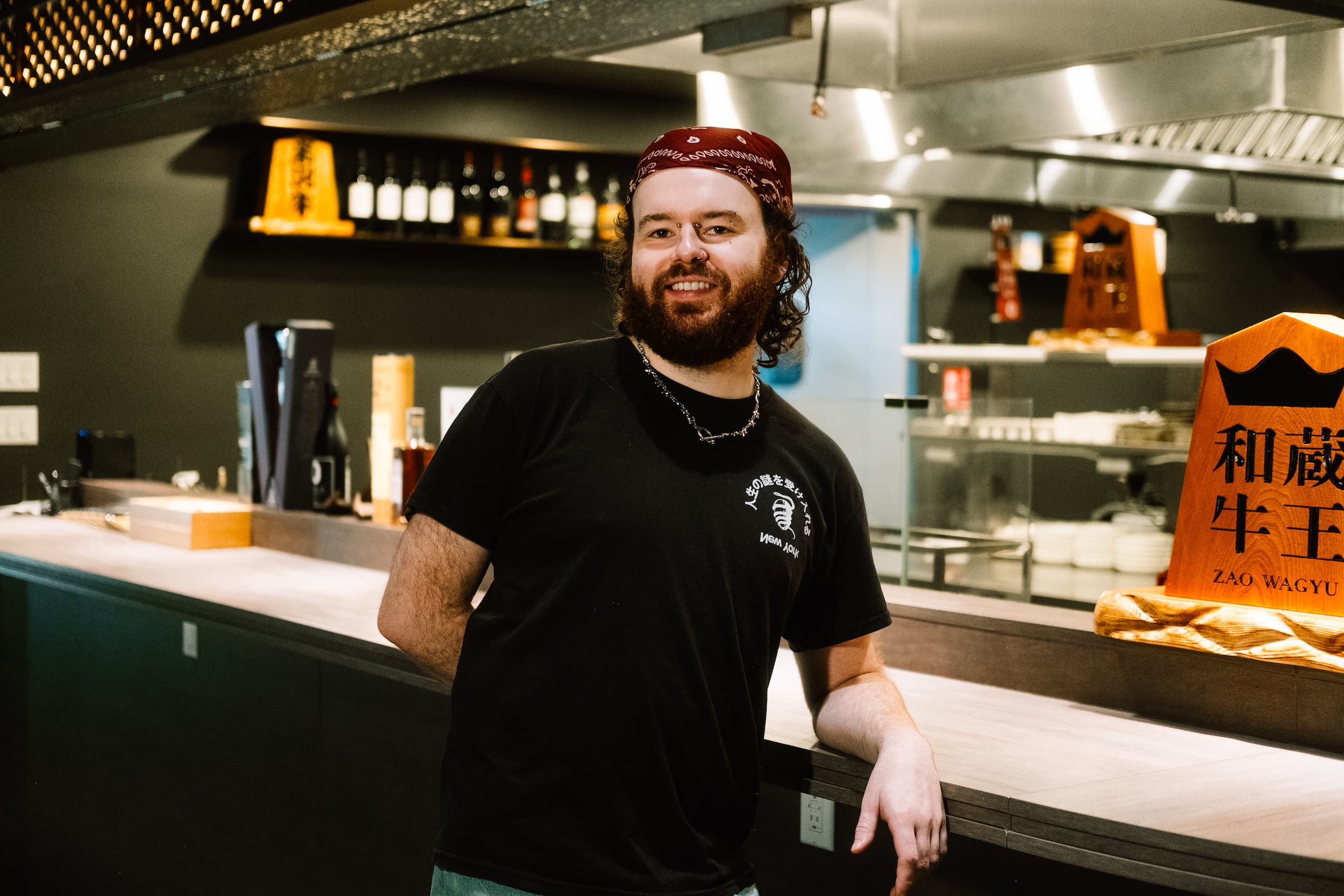
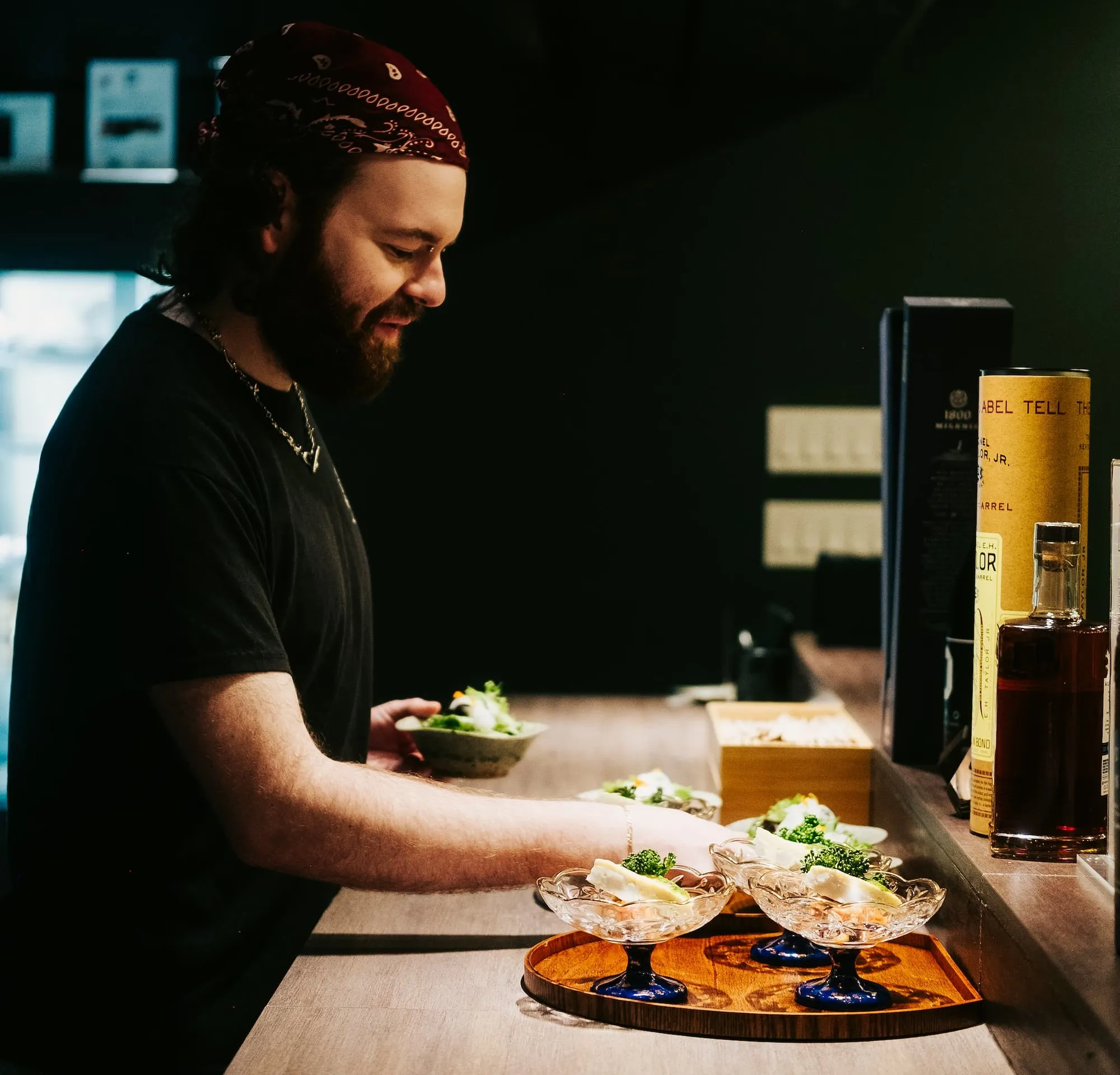
Outside of his artistic practice, Fabricant remains close to New York’s food and beverage industry. He’s felt comfortable with the energy of hospitality since he was a teenager, and waiting tables in the city furthered his skills. In the months leading up to his exhibition, he started serving at Togyushi, a new omakase restaurant in Midtown, Manhattan. Much like his desire to instill playfulness, wonder, and experimentation into his artwork, Togyushi’s dark, sleek wooden walls hold master chefs who bring the same attitude to the culture and practice of omakase. The bonsai trees, expansive sushi bar, and open kitchen offer the artist a calming respite. Like anything he’s ever enjoyed, he approaches serving with a sense of appreciation for diving into something new.
In May of 2025, Fabricant found another opportunity to embrace new challenges by joining the In Person Art Crit Club. The club provided a creative community that inspired Fabricant to take his art to new heights. For the first time in his artistic career, he has a space to share his journey with others. After bringing in an early rendition of his sardine on muslin, the group encouraged him to apply for a space in Hartman’s exhibition. Now, New Sardines hangs on the wall in animated completion. Fabricant speaks highly of the artists he’s met in the club, and how they’ve made him feel about his career.
“I want to just keep getting bigger and I want to apply to more shows. Before this, I had never applied for anything. I never knew how to go about getting my art in a show. I was just making it to hang in my apartment. The community in the Crit Club is teaching me how to get featured.”
Looking forward, Fabricant is expanding New Sardines into a series of other mixed media pieces. His new work begins the same way: sketches, loose fabric, color palettes, and inspiration from his life as a New Yorker. He welcomes the lessons and mistakes ahead with the same joy he’s found in everything worthwhile.
“It’s the best feeling on earth, because it just becomes this greater climb. It's just a never ending climb of wanting to do better.”